St. John's Pond.
A living history.

One of the most photographed places in Cold Spring Harbor — and one of the most ecologically significant on Long Island's north shore.

St. John's Pond is not simply a scenic feature of our landscape. It is a functioning freshwater ecosystem — one that reflects the health of the watershed that feeds it and the care of the community around it. For more than three centuries, it has defined the character of this place and sustained the life that depends on it.

Today, the pond stands at a threshold. The science is clear about the stresses it faces. But the science is equally clear about something else: restoration is still possible. The ecological foundation has not collapsed. The window is open — but it will not remain so indefinitely.


A Brief History

Three centuries
at the center of community life.

Late 17th Century
St. John's Lake
The first mills were established along what was then called St. John's Lake, marking the beginning of the pond's long relationship with human settlement in Cold Spring Harbor.
Early 20th Century
Dam Failure & Reconstruction
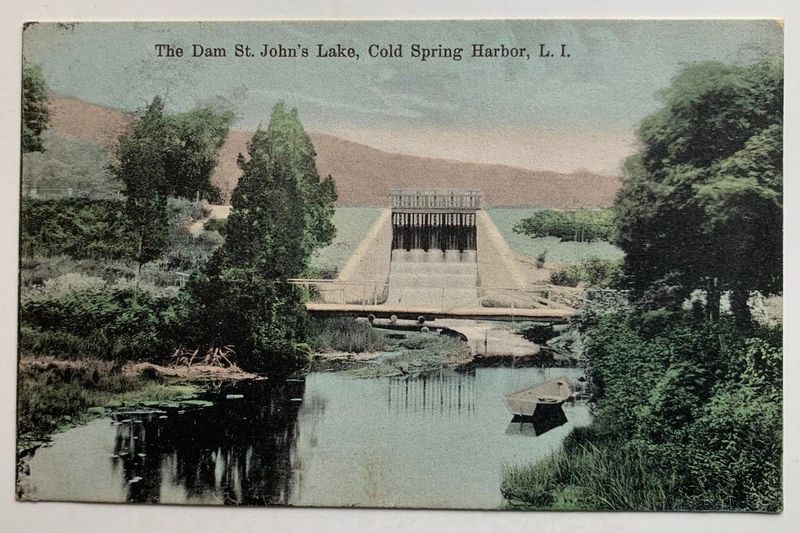
The original dam failed in the 1920s — approximately twenty years after its construction — and was rebuilt. That rebuilt structure, now over a century old, remains in place today. The wooden spillway weir at its center is the focus of our most urgent work.
Living Memory
Ice Skating, Fishing & Gathering
Generations of Cold Spring Harbor residents carry memories of skating on the frozen pond in winter, fishing for bluegill on warm afternoons, and gathering at its edge for Concerts by the Pond in summer. These are not simply nostalgic details — they speak to what this place means and why it matters.
2025–Present
The Restoration Begins
A major fundraiser raised more than $370,000. The pond edge was rebuilt. Native plant riparian buffers were installed. GEI Consultants completed a comprehensive scientific assessment. Verdantas was engaged to lead dam and weir engineering. The St. John's Pond Watershed Alliance was formally incorporated. The work — real, sustained, science-guided — has begun.
1909 postcard of St. John's Pond

Historical Record

Documented since
the earliest maps.

St. John's Pond appears in Belcher Atlas maps from 1914 and in photographic records stretching back more than a century. Its shoreline, its church, and its dam are among the most recognizable images associated with Cold Spring Harbor.

That visual legacy is not just historical sentiment — it reflects the degree to which this pond has shaped the identity of the community around it.

0
Invasive Aquatic Plants
GEI found no aquatic invasive species — a remarkable finding for Long Island
Elevated Nitrogen
Nitrogen levels nearly double — and sometimes quadruple — healthy thresholds
96.6%
Nitrogen Removal
Pickerelweed removed 96.6% of nitrate in a local student's AP Research study
7
Protected Species
Federally listed endangered or threatened species with habitat in this watershed

Wildlife

What lives here
depends on this.

Endangered
Northern Long-Eared Bat
Myotis septentrionalis
Mammal
Proposed Endangered
Tricolored Bat
Perimyotis subflavus
Mammal
Threatened
Piping Plover
Charadrius melodus
Bird
Endangered
Roseate Tern
Sterna dougallii dougallii
Bird
Proposed Threatened
Monarch Butterfly
Danaus plexippus
Insect
Endangered
Sandplain Gerardia
Agalinis acuta
Flowering Plant

Plus 25 additional migratory bird species, including the Bald Eagle (Haliaeetus leucocephalus)

"I've been on, in, or near this water most of my life. I didn't know about nitrogen cycles or trophic cascades. I just knew this place mattered."

Woodford Pollach, AP Research — Pickerelweed Nitrogen Removal Study, Cold Spring Harbor

96%

Nitrate removed from pond water by native pickerelweed in a three-week study — showing nature's own solution already grows at the water's edge

The pond is calling.
Will you answer?

Your support funds the science, the engineering, and the sustained community effort that will determine this pond's future.

Support the Restoration See Our Work